Text
Few political institutions have shaped the modern world as profoundly as the nation-state. Few have generated as much confusion about the relationship between nations and political power. Both nationalists and globalists assume that complex social orders can be deliberately designed and imposed by a centralized authority. They treat nations as if they could be rigidly confined within fixed political structures, ignoring the tensions such constraints generate.
Social order emerges through decentralized processes. From this perspective, the nation-state should be judged by a simple standard: does it expand voluntary cooperation and individual agency, or does it restrict them?
The nation-state cannot be regarded as a necessary or stable system and should instead give way to more competitive and decentralized systems of governance. Epistemic, moral, social, and political limitations are inherent in the attempt to impose fixed structures upon changing social realities. Such a view does not imply the absence of political organization, but rather the free emergence of decentralized and competitive systems of governance that better reflect the fluid state of nations. A free society requires nations that are not constrained by imposed, top-down political structures, but are free to evolve alongside the social order.
To understand why, it is necessary to establish a clear conceptual separation between the notions of nation and state. The nation is a spontaneous order emerging from patterned human interactions over time, including language, shared history, culture, and religion (Hayek, The Fatal Conceit). Nations are fundamentally non-territorial. The case of the Kurds illustrates this clearly, as they constitute a nation with a shared cultural and historical continuity persisting across multiple political jurisdictions without a unified state (FairPlanet).
Nations, however, are not fixed entities. As history shows, they are in a constant process of evolution, overlap, and competition with other cultural orders. Empirical research supports this view. Kunst and Mesoudi have argued that cultural and national identities evolve through decentralized mechanisms such as imitation, prestige-based learning, and intergenerational transmission.
These dynamics can be further understood through Israel Kirzner’s theory of entrepreneurial discovery. Just as entrepreneurs respond to previously unnoticed opportunities in the market, individuals within society discover and coordinate around shared linguistic and cultural patterns. Through this decentralized process, the nation is continuously reshaped (Kirzner).
The state has a different meaning. Ludwig von Mises conceptualizes it as an institutionalized apparatus of coercion. Unlike the nation, it is not the result of spontaneous processes, but rather of deliberate political construction (Mises, Human Action).
Yet if nations evolve through countless individual interactions, cultural exchanges and historic contingencies, it is difficult to see how any central authority could successfully direct their development. The information that shapes a nation is dispersed, tacit, and context-dependent, and therefore cannot be fully aggregated within a central authority (Hayek, “The Use of Knowledge in Society”). As Hayek argued, attempts to centralize this dispersed knowledge are inherently limited and tend to generate distortions in both economic coordination and broader social structures.
The implications for the nation-state are profound. Any attempt to politically define, manage or reshape a nation confronts the same epistemic limits. Because nations evolve through decentralized processes that no authority can fully comprehend, attempts to define or manage them politically often produce instability, conflict, and, in extreme cases, violence.
At this point, an objection naturally arises. Even if nations evolve spontaneously, does modern society not require centralized political structures capable of coordinating millions of people? This was the argument advanced by Ernest Gellner and other modernist theorists of nationalism. In their view, industrialization demanded cultural standardization, linguistic uniformity, and central institutions capable of coordinating large populations. The nation-state was therefore not an accident of history, but a product of modern social and economic realities (Conversi).
Gellner was right to observe that industrialization increased the demand for broader coordination across larger populations. The question is whether political centralization was the only way to achieve it. History suggests otherwise. Before German unification in 1871, a largely shared cultural identity was divided across multiple political units (see Figure 1). Yet some of the most important advances in economic integration occurred before political unification itself.
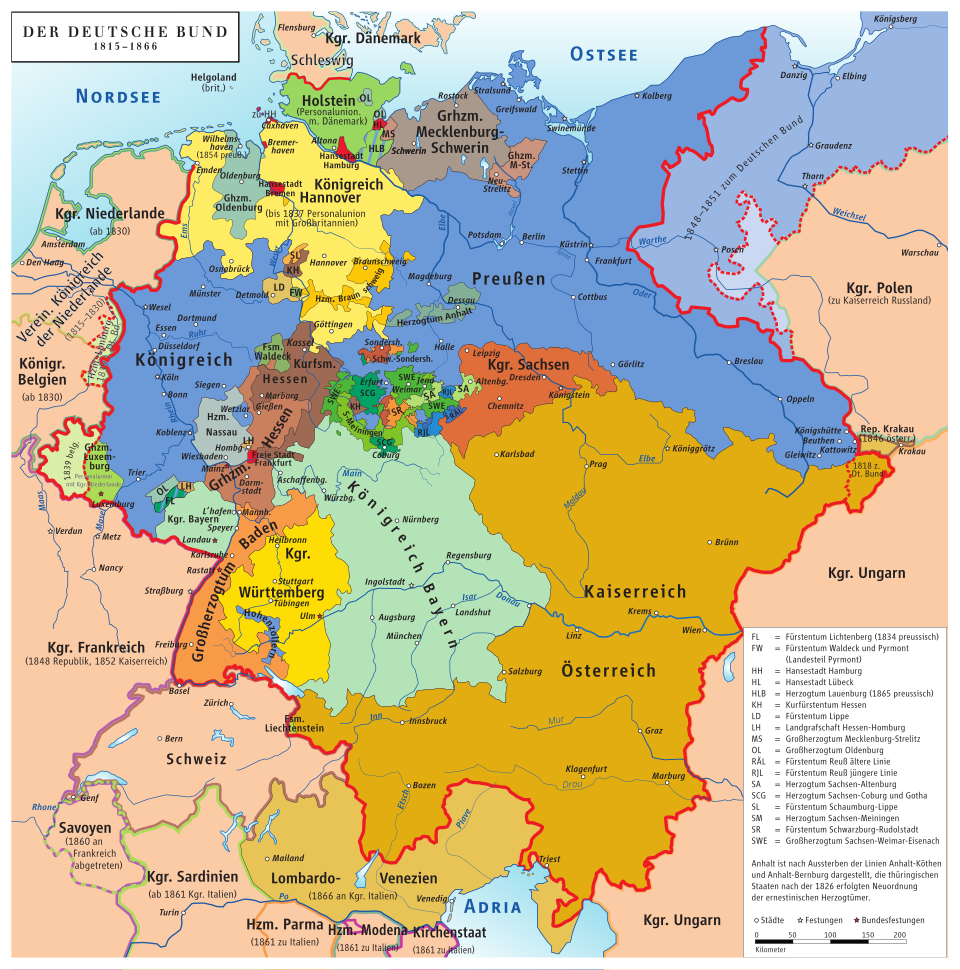
Even though proto-industrialization had begun around 1815, economic development remained slow, fragmented, and constrained by internal trade barriers. This changed with the establishment of the Zollverein (German Customs Union), which eliminated internal trade barriers between German states. This marked a turning point for industrial development. The expansion of market size and the increasing scope for free enterprise—particularly in Prussia— enabled significant economic growth across the German territories (Dohmen).
Germany was hardly unique in this respect. Complex economic coordination does not depend on political centralization, but rather on the removal of barriers to interaction. This flaw in modernist theories of nationalism arises from a fundamental confusion between the political organization of society and the social nature of nations. The coordination required by industrialization can emerge through different institutional paths: either through the expansion of trade and voluntary cooperation, or through political centralization, which introduces its own problems.
The nation-state is not merely an imperfect institutional arrangement, but rather a structurally coercive attempt to confine an inherently dynamic reality—namely, the nation—within pre-established territorial boundaries (Mises, Nation, State, and Economy). This is not a case of necessary coercion in pursuit of a greater good, but rather a form of systematic imposition that generates persistent conflict and degrades the nation as a voluntary and identity-based social order.
The partition of India and Pakistan illustrates how the imposition of political boundaries upon heterogeneous and overlapping identities generates large-scale conflict and enduring intergenerational resentment between communities (Suzuki). Similarly, the disintegration of Yugoslavia demonstrates that attempts to politically contain multiple evolving nations within a single state generate violent conflict, as evidenced by the Yugoslav wars.
If nations are dynamic, evolving social orders, any political framework must be compatible with their spontaneous nature rather than attempting to override it. The core problem is not political organization per se, but the imposition of rigid, monopolistic structures upon processes that are inherently fluid. A society that seeks to accommodate this reality must therefore rest on three principles: decentralized self-determination, unrestricted free trade across political boundaries, and the free movement of individuals across jurisdictions (Jesús Huerta de Soto):
The principle of self-determination holds that any national group must be free to decide which political jurisdiction it wishes to belong to. In other words, political affiliation should be the result of voluntary choice rather than imposed boundaries. Therefore, a single national community may be dispersed across multiple political states. Take, for example, the case of the English-speaking world, which, despite sharing a common linguistic and cultural foundation, is distributed across distinct political units such as the United States of America, the United Kingdom, Canada, and Australia.
Most secessionist movements betray this principle by refusing to apply it consistently to all levels of society. As a result, they reject the possibility that, within a seceding nation, smaller groups may themselves choose to secede or to join another political state. The Catalan independence movement exemplifies this. While many of its supporters defend Catalonia’s right to determine its own political future independent of Spain, far less attention is given to the possibility that municipalities, regions or communities within Catalonia might themselves choose a different political jurisdiction. Self-determination becomes difficult to defend as a principle when it is applied selectively.
A newly formed secessionist state must therefore avoid reproducing the very coercive structures it previously opposed by imposing its will on internal minorities.
If nations are free to evolve politically, they must also remain free to cooperate economically. In a world characterized by an advanced international division of labor, no political unit possesses all the resources it requires. In such a fragmented order, the absence of unrestricted free trade inevitably pushes polities toward autarky and protectionism. Given their inherent unsustainability, such policies generate structural incentives for expansion, as polities seek to secure access to resources, markets, and productive capacity beyond their borders.
Protectionism does more than disrupt economic coordination. By limiting access to markets and resources, it creates political pressures that can easily spill into conflict.
Free trade offers an alternative to this dynamic. It allows societies to gain peaceful economic coordination and access to markets and productive capacities without recourse to conflict. Economic openness promotes prosperity, but it also promotes peace. Large-scale panel studies find that countries that trade more are less likely to engage in interstate conflict (Lee and Pyun).
A decentralized order also depends on the ability of individuals to move freely across political jurisdictions. In the absence of free movement, economic, political, and social disparities between groups become rigid, generating persistent tensions between communities. When political boundaries divide groups across different jurisdictions and restrict interaction, these tensions are intensified rather than resolved. Historically, such mismatches have often contributed to conflict, as illustrated by cases of irredentism such as Somalia’s attempts to unify Somali populations across borders. Where nations are free to evolve, such tensions could be addressed through decentralized mechanisms, such as recursive secession. However, where such processes are not feasible, the free movement of individuals provides an alternative adjustment mechanism.
Free movement also encourages competition between jurisdictions. Individuals are no longer locked into a particular political system, but can choose those that offer greater stability, prosperity, and freedom. Polities that fail to attract or retain residents face increasing pressure to improve, while those that govern effectively are rewarded through voluntary migration.
Together, these principles point toward a fundamentally different social order. This is not a utopian construct, but rather a spontaneous order that reflects the dynamic nature of nations, evolving continuously in response to changing cultural and economic conditions. A detailed description of such a system is neither possible nor necessary, as spontaneous orders cannot be predicted in advance, let alone over extended periods of time.
While its precise configuration cannot be predicted, the forces that would shape it are not difficult to identify. In such a system, political jurisdictions are no longer monopolistic structures, but rather decentralized institutions, shaped by individual choices and competitive pressures. Conflicts between minority groups and political authorities would no longer be addressed through coercion, but rather through mechanisms such as mobility, competition, and recursive self-determination.
At first glance, a society built on free movement and decentralized governance may appear unstable. Rapid and uncoordinated change can certainly produce short-term instability. Yet decentralization is not synonymous with disorder. Free movement replaces territorial adjustments achieved through conflict with the voluntary relocation of individuals. Far from undermining coordination, decentralization creates the conditions under which it can emerge. (Hayek, “Planning, Science and Freedom”).
The result is a vision of political order very different from both the traditional nation-state and contemporary alternatives. Systems of global governance and supranational institutions may differ in scale, but they share the same basic assumption: that evolving nations can be accommodated within fixed political structures. The argument here suggests otherwise.
Conclusion
In light of this, the question is not whether the nation-state should remain or be abolished, but whether the nation must remain imprisoned within the state. Nations are not designed, but discovered; not imposed, but evolved. Shaped by culture, language, and human interaction, they remain fluid and overlapping.
A free society neither abolishes nations nor absolutizes states; it allows nations to emerge freely. Where borders lose their economic and coercive significance, nations cease to be battlefields and instead become mechanisms of cooperation.
The tragedy of modern nationalism is not that nations exist, but that they have so often been turned into instruments of power. What should unite individuals has been used to divide; what should be free has been imposed by force.
The nation will endure, not as a cage imposed from above, but as a living order arising from below.
Works Cited
Cinar, Kursat. “Dismemberment of Yugoslavia: Lessons for the Ethnic Conflict Literature” - Balkan Journal of Social Sciences. vol. 8, Mar. 2019, pp. 15–27.
Conversi, Daniele. “Ernest Gellner’s Theory of Nationalism.” 2001.
Dohmen, Martin. “Freedom of Enterprise and Economic Development in the German Industrial Take-Off.” European Economic Review, vol. 148, Sept. 2022, p. 104163. https://doi.org/10.1016/j.euroecorev.2022.104163.
FairPlanet. “The Kurds: A Stateless Nation Striving for Self-Determination.” FairPlanet, https://www.fairplanet.org/dossier/beyond-citizenship/the-kurds-a-stateless-nation/. Accessed 2 Apr. 2026.
Hayek, F. A. “Planning, Science and Freedom.” Nature, vol. 148, no. 3759, Nov. 1941, pp. 580–84. https://doi.org/10.1038/148580a0.
———. The Fatal Conceit: The Errors of Socialism. Routledge, 1998.
———. “The Use of Knowledge in Society.” The American Economic Review, vol. 35, no. 4, 1945, pp. 519–30.
Huerta de Soto, Jesús. “Teoría del nacionalismo libertario.” Nuevos Ensayos de Economía Política, Unión Editorial, 2023, pp. 101–19.
Kirzner, Israel M. Competition and Entrepreneurship. University of Chicago Press, 1978.
Kunst, Jonas R., and Alex Mesoudi. “Decoding the Dynamics of Cultural Change: A Cultural Evolution Approach to the Psychology of Acculturation.” Personality and Social Psychology Review, vol. 29, no. 2, May 2025, pp. 111–44. https://doi.org/10.1177/10888683241258406.
Lee, Jong-Wha. Does Trade Integration Contribute to Peace?, Jan. 2009. https://www.adb.org/publications/does-trade-integration-contribute-peace.
Mises, Ludwig von. Human Action: A Treatise on Economics. Liberty Fund, 2010.
———. Nation, State, and Economy. Liberty Fund, 2012. https://muse.jhu.edu/pub/226/monograph/book/18167.
Suzuki, Akisato. “Partition and Conflict Transformation in India-Pakistan and Cyprus.” Federal Governance, May 2011. https://doi.org/10.24908/fg.v8i2.4377.